WhatsApp's General-Purpose AI Chatbot Ban, by Country
The short answer
Since 15 January 2026, Meta's WhatsApp Business Platform terms bar AI Providers when AI is "the primary (rather than incidental or ancillary) functionality". Meta permits it only where legally required: Türkiye, Brazil, Italy and 29 other European countries. India is not listed. The wording does not target businesses using AI for their own customers (checked October 2026).
Is a general-purpose AI chatbot allowed on the WhatsApp Business API?
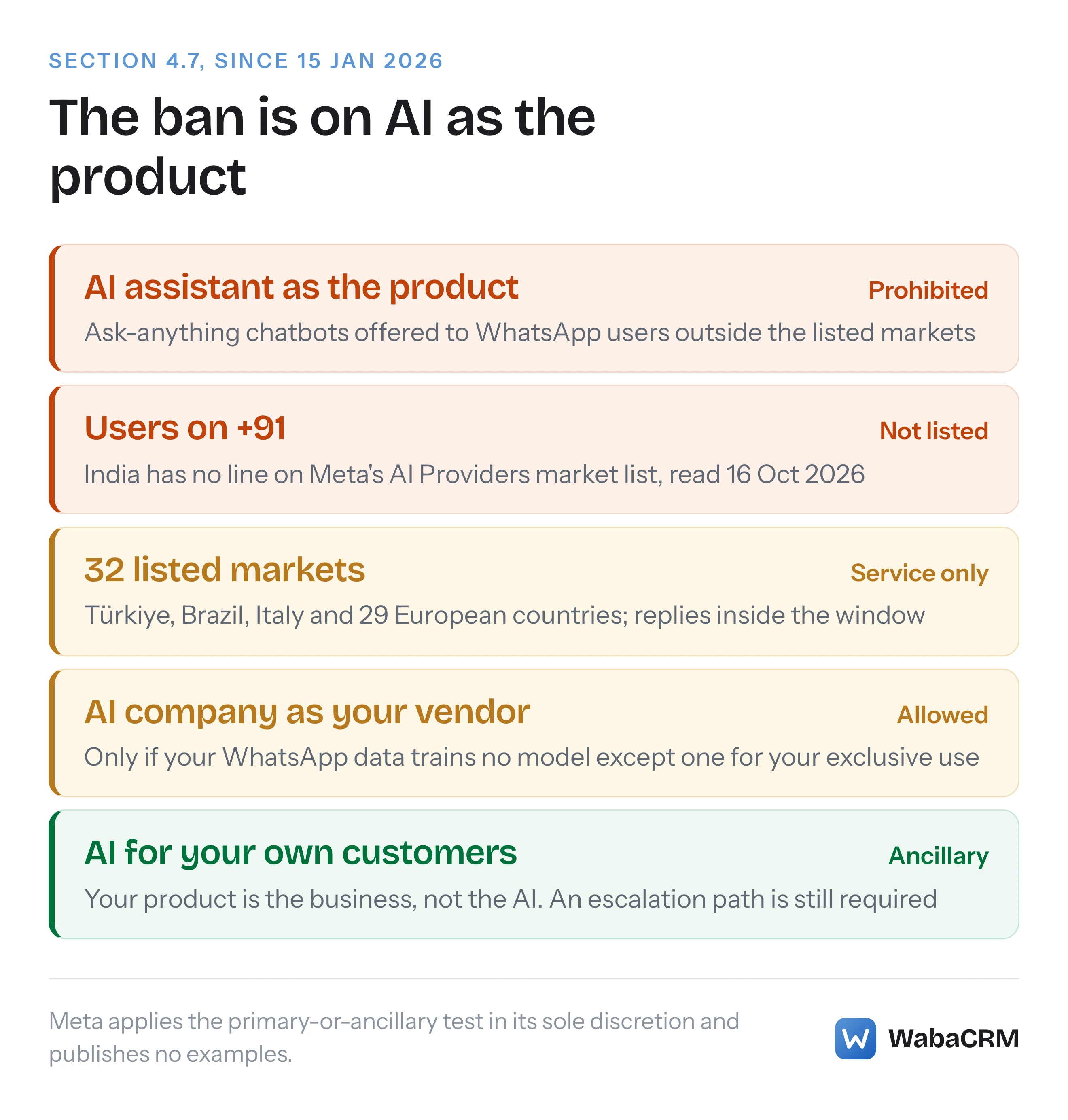
Only in a short list of markets, and India is not one of them. Since 15 January 2026, Meta's terms have barred "AI Providers" from offering their technology on the WhatsApp Business Platform when that technology is the product itself, rather than something a business uses while selling something else.
The rule is section 4.7 of the Meta Terms for WhatsApp Business Platform, the contract every business and every vendor on the platform accepts:
"Providers and developers of artificial intelligence or machine learning technologies, including but not limited to large language models, generative artificial intelligence platforms, general-purpose artificial intelligence assistants, or similar technologies as determined by Meta in its sole discretion ("AI Providers"), are strictly prohibited from accessing or using the WhatsApp Business Platform, whether directly or indirectly, for the purposes of providing, delivering, offering, selling, or otherwise making available such technologies when such technologies are the primary (rather than incidental or ancillary) functionality being made available for use, as determined by Meta in its sole discretion; provided, however, that such technologies may be made available to businesses in certain countries as set forth here." (Meta Terms for WhatsApp Business Platform, §4.7)
Two very different businesses read that paragraph and both worry. The first sells an AI assistant: you message its number and it answers anything, from homework to recipes to code. The second is a shop, a clinic or a coaching institute that has put a language model behind its own WhatsApp number, so a customer asking about an order or a batch timing at 11pm gets an answer. The clause was written about the first. The hinge is seven words, "primary (rather than incidental or ancillary) functionality", and the sentence says twice that Meta alone decides how they apply.
- Is a general-purpose AI chatbot allowed on the WhatsApp Business API?
- Which words in section 4.7 decide whether you are an AI Provider?
- Which countries can AI providers still reach on WhatsApp?
- Is India on Meta's list for AI providers?
- Does an AI bot answering your own customers count as the primary functionality?
- What does WhatsApp's messaging policy ask of an automated support bot?
- Can a business hire an AI company as its WhatsApp vendor?
- What do general_purpose_ai and AI_BOT mean in your billing data?
- Is Meta's own AI agent covered by the same clause?
- Which side of the line does a WabaCRM AI agent sit on?
- What should a WhatsApp product that is mostly AI check now?
Which words in section 4.7 decide whether you are an AI Provider?
Four phrases do the work: who counts as an AI Provider, the "primary" test, the reach of "directly or indirectly", and the proviso pointing to a list of countries. Everything else in the paragraph is the prohibition they qualify.
| Words in the clause | What they do |
|---|---|
| "Providers and developers of artificial intelligence or machine learning technologies" | Names who is covered: makers of language models, generative platforms and general-purpose assistants |
| "or similar technologies as determined by Meta" | Leaves the list open for Meta to extend |
| "whether directly or indirectly" | Covers reaching WhatsApp through someone else's account or platform |
| "primary (rather than incidental or ancillary) functionality" | The test: is the AI the thing being made available? |
| "as determined by Meta in its sole discretion" | Meta applies the test, not the business |
| "certain countries as set forth here" | Links to the market list on Meta's AI Providers pricing page |
The phrase "directly or indirectly" closes the obvious workaround. On its plain words, an AI company does not escape the clause by having a reseller or a messaging platform hold the number for it, because using the platform indirectly to make the assistant available is named in the same breath as using it directly.
What Meta has not written matters as much. Neither the terms nor the AI Providers page gives a single example of "incidental or ancillary" use, a threshold, or an appeal route specific to this clause. I read both on 16 October 2026 looking for one. Every judgement in the rest of this article is therefore a reading of the words, and the words end with Meta deciding.
Which countries can AI providers still reach on WhatsApp?
Thirty-two markets, read on 16 October 2026: Türkiye, Brazil, Italy and 29 other European countries. Meta's AI Providers page says they are permitted only where the law forces Meta's hand:
"Effective January 15, 2026, WhatsApp’s Terms of Service update “AI Providers” are only permitted to offer general-purpose AI assistants on the WhatsApp Business Platform where Meta is legally required to permit this use case." (Meta — New pricing policy for AI Providers)
That sentence is quoted exactly, grammar included. The page then lists each market with the date it opened and what Meta charges there:
| Market | Allowed since | What Meta charges |
|---|---|---|
| Türkiye (+90) | 15 October 2026 | Nothing, "through April 11, 2027" |
| Brazil (+55) | 11 March 2026 | The published AI Provider rates |
| 29 European countries | 11 March 2026 | Charged to 12 May 2026; nothing since 13 May 2026 |
| Italy (+39) | 16 February 2026 | Charged to 12 May 2026; nothing since 13 May 2026 |
The 29 are listed one by one with their calling codes: Austria, Belgium, Bulgaria, Croatia, Cyprus, the Czech Republic, Denmark, Estonia, Finland, France, Germany, Greece, Hungary, Iceland, Ireland, Latvia, Liechtenstein, Lithuania, Luxembourg, Malta, the Netherlands, Norway, Poland, Portugal, Romania, Slovakia, Slovenia, Spain and Sweden. Together with Italy that is every EU member state plus Iceland, Liechtenstein and Norway, although Meta's page does not use the words "EU" or "EEA". The United Kingdom, Switzerland and the United States are not on it.
Three details are easy to miss:
- Meta names no law. The page rests every market on Meta being "legally required" to permit the use, and never identifies the statute or the regulator behind any of them.
- The list is keyed to the user's calling code. Each line reads "AI Providers can send service messages to users in this market", with the code in brackets. The terms phrase the same exception differently, as technologies "made available to businesses in certain countries". The page the terms link to is the operative list, and it speaks about where the WhatsApp user is.
- It only covers service messages. Among the things the page says it does not change: "The dynamics of the customer service window; service messages can still only be sent in response to users, during an open 24-hour customer service window." An AI Provider in a permitted market still cannot start a conversation with free-form text.
Meta's general pricing page adds one more line that keeps AI Providers apart from everyone else: "Pricing updates for service messages launching October 1, 2026 do not apply to AI Providers; see the AI Providers pricing policy for how Meta charges them for service messages." (Meta — Pricing on the WhatsApp Business Platform) What the October change did to every other business is covered in the service message pricing explainer.
Is India on Meta's list for AI providers?
No. There is no +91 line on Meta's AI Providers page as read on 16 October 2026, so a general-purpose AI assistant offered by an AI Provider to users with Indian numbers is outside what the terms permit.
The products most exposed are the ones whose whole offer is the conversation with the model: an "ask me anything" assistant, a homework helper that answers any question in any subject, a general writing or coding bot reached through a WhatsApp number. Whether a narrower product, such as a tutor tied to one institute's own syllabus, is "primary" or "ancillary" is exactly the judgement the clause leaves to Meta, and nothing on either page settles it.
Two things follow for an Indian business:
- Reading the list as a waiting room is a guess. Every line on it rests on a legal requirement, by Meta's own description. Nothing on the page describes a way to apply for a market, and nothing says India is under review.
- The list moves, but not on request. Markets opened in February and March 2026, the charges changed in May, and Türkiye was added on 15 October 2026. Each change arrived as a dated line on the page, never as an application process.
None of this touches an Indian shop, clinic or institute using AI on its own number to answer its own customers, which is the next question.
Does an AI bot answering your own customers count as the primary functionality?
On the clause's own wording, no. A business whose product is shoes, courses or appointments is making those available on WhatsApp, and the model that answers questions about them is incidental or ancillary to that. Meta still makes the final call.
Meta's own pricing documentation treats AI-written replies from ordinary businesses as a normal, expected thing. Its definition of a service message reads:
"Service – Any non-template message not powered by the Meta Business Agent Platform. These can be powered by a 3rd-party AI solution or people (like customer service representatives)." (Meta — Pricing on the WhatsApp Business Platform)
And the AI Providers page is explicit that it is a carve-out, not a new rule for everyone: "This page is specific to “AI Providers” using the WhatsApp Business Platform. This does NOT change how Meta charges all other businesses using the WhatsApp Business Platform." (Meta — AI Providers)
Since Meta publishes no test, here are three questions that follow the words of the clause. They are a reading, not Meta's criteria:
- What does the customer come to your number for? An order, a booking, a refund: the AI is a tool. The AI conversation itself: the AI is the product.
- Would the conversation exist without the model? A support chat would, with a person answering. An assistant's chat would not.
- Does the bot stay on your business? Answers about your own catalogue, prices and policies sit on the ancillary side. A bot that will happily write an essay on any subject is offering general-purpose AI, whatever the business behind it sells.
What does WhatsApp's messaging policy ask of an automated support bot?
An escalation path. The WhatsApp Business Messaging Policy does not mention AI Providers at all, but it does put a condition on any automation that replies to customers:
"You may use automation when responding during the 24-hour window, but must also have available prompt, clear, and direct escalation paths. These escalation paths include:
- In-Chat Human Agent transfer
- Phone number
- Web support (on the business website)
- In-store visits (ex: visit retail store, bank branch), or
- Support form" (WhatsApp Business Messaging Policy)
The policy, last updated 23 September 2026, introduces the six with "include" and ranks none above the others, so on its wording a bot that tells a customer which number to call meets the rule as much as one that hands the chat to a person. The same policy sets the window the bot works inside: "You may reply to a user message without use of a Message Template as long as it’s within the 24-hour customer service window, which opens and resets with each user message."
So the rule that actually binds a support bot is not section 4.7. It is this one, and it is easy to meet and easy to forget.
Can a business hire an AI company as its WhatsApp vendor?
Yes. The same section of the terms that bars AI Providers from offering AI as the product lets a business retain one as its vendor, with a condition on the data:
"Notwithstanding the foregoing, you may retain an AI Provider as your Solution Provider. In such cases, you may not directly or indirectly allow WhatsApp Business Platform Data, including any anonymous, aggregate, or derived forms of WhatsApp Business Platform Data, to be used to create, develop, train, or improve any machine learning or artificial intelligence systems, models, or technologies, including large language models (collectively, "AI Models"); provided that you may use WhatsApp Business Platform Data to fine-tune an AI Model that is for your exclusive use, so long as this does not result in WhatsApp Business Platform Data being used to create, develop, train, or improve any other AI Models." (Meta Terms for WhatsApp Business Platform, §4.7)
"Solution Provider" here is the terms' own defined word, not Meta's partner tier. Section 1.1 defines it as "a third party authorized to use these APIs on such business' behalf", which covers any platform that sends and receives on your number, whatever its partner status.
Notice who the obligation binds: "you". The clause says you may not "directly or indirectly allow" the training, so if your vendor's model provider trains on the transcripts it receives, it is your obligation at stake, not only theirs. Section 4.1(b) adds a general limit on where the data may go at all: a business must not "share, transfer, sell, license, or distribute WhatsApp Business Platform Data, including any anonymous, aggregate, or derived forms or data, to any third parties, except to a Solution Provider in accordance with these Terms."
Four questions worth putting to any vendor in writing:
- Which model provider receives our conversation text, and how much of each thread?
- Do that provider's terms allow it to train on what it receives?
- If a model is fine-tuned on our data, is it ours alone?
- Does anything derived from our chats, such as embeddings or summaries, feed a shared model?
What do general_purpose_ai and AI_BOT mean in your billing data?
They are the two names Meta gives AI Provider traffic: general_purpose_ai in the status webhook and AI_BOT in the Pricing Analytics API. An ordinary business using AI for its own support should see neither.
"The webhooks will reflect the <PRICING_CATEGORY> for these non-template messages from “AI Providers” as general_purpose_ai." (Meta — AI Providers)
The same page shows the pricing object a billable AI Provider message carries on its status webhook:
"pricing": {
  "billable": true,
  "pricing_model": "PMP",
  "type": "regular",
  "category": "general_purpose_ai"
}
And for analytics: "The Pricing Analytics API will include a new <PRICING_CATEGORY> value of AI_BOT to reflect AI Provider traffic."
Here is the trap for anyone parsing these webhooks. Meta's status messages webhook reference, updated 14 September 2026, lists the values pricing.category can take, and general_purpose_ai is not among them: it lists authentication, authentication-international, group_marketing, group_service, group_utility, marketing, marketing_lite, referral_conversion, service and utility (Meta — Status messages webhook reference). Code that validates the field against that list will reject or drop a value Meta documents on another page. Store unknown categories rather than refusing them.
For an ordinary business, an AI-drafted reply should arrive as service, like any other reply in the window. If general_purpose_ai ever appears against your own number, Meta is treating your traffic as AI Provider traffic, and that is worth raising with Meta before anything else.
Is Meta's own AI agent covered by the same clause?
Not by this clause. Meta's own AI for businesses runs under separate terms, which section 1.3 points to directly:
"For example, the Meta Business Agents and Platform Terms of Service apply when you access, enable, or use optional Business Agents (as defined therein) in connection with the WhatsApp Business Platform, and different or additional terms may apply when you access and use other AI-related technologies in connection with the WhatsApp Business Platform." (Meta Terms for WhatsApp Business Platform, §1.3)
So there are three positions, not two: an AI Provider offering AI as the product (section 4.7), Meta's own Business Agent (its own terms and its own pricing category), and a business using a third-party model to answer its own customers (an ordinary service message). How Meta's agent compares with one a business writes itself, including the difference in billing, is set out in the guide to WhatsApp AI agents for business.
Which side of the line does a WabaCRM AI agent sit on?
The ancillary side, by design. WabaCRM is a Meta-verified Tech Provider whose AI agents answer a business's own customers about that business, from instructions and documents the business writes, and they are built to hand over to a person.
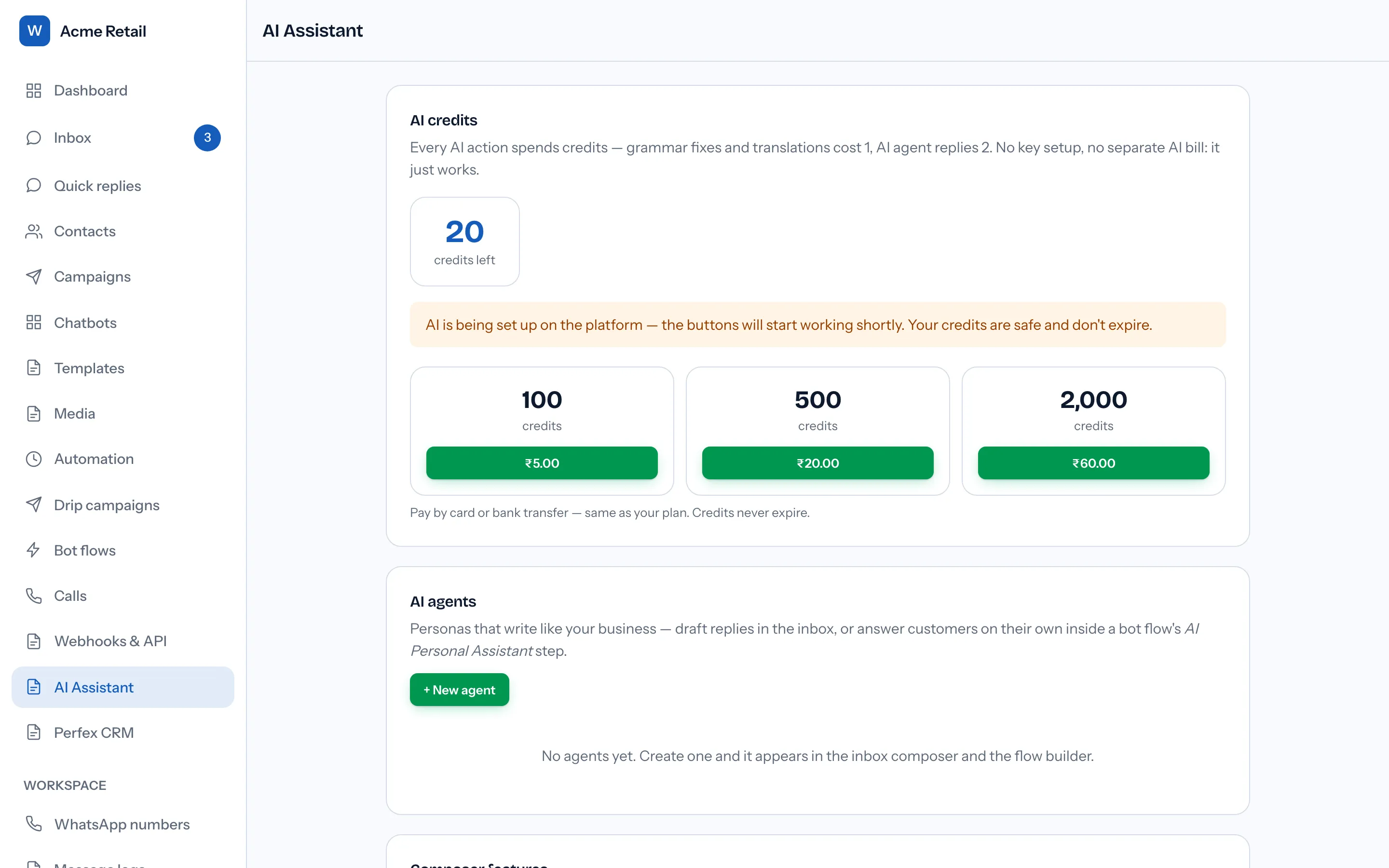
What the AI Assistant add-on actually does, as built:
- It drafts by default. A teammate picks an agent in the inbox composer, the agent writes the next reply, and nothing is sent until the teammate presses Send.
- It answers alone only inside a bot flow step, on WhatsApp, for a capped number of replies, and the bot flow builder is an optional add-on of its own.
- It is told to hand over. Every agent carries a fixed instruction to say a teammate will take over when it cannot help or the customer asks for a person. That is one way to give customers the in-chat escalation path the messaging policy asks for, provided someone on the team is watching.
- It spends AI credits for every grammar fix, translation, draft and reply, and credits are bought in packs, separately from the contact-based plan. The add-on and credit packs are listed, with their current terms, on the pricing page.
On the training clause: each AI draft or flow reply sends up to the last 12 messages of the thread, and any matching knowledge-base passages, to the platform's AI provider to write one reply; a grammar fix or translation sends only the draft being edited. It has no training or fine-tuning step, and WabaCRM's privacy policy states "We do not use message content or contact data to train machine learning models." Section 4.7 makes the business answerable for where its WhatsApp data goes, so read that sentence alongside the questions in the vendor section above, for this product and any other.
What should a WhatsApp product that is mostly AI check now?
Four checks, in order of how much they can cost you.
- Decide which side you are on, honestly. Use the three questions above. If the AI conversation is what people come for, assume section 4.7 applies to you.
- Map your users by calling code. If most of them are on +91 or any other code missing from Meta's list, a general-purpose assistant for them is outside the terms. Restrictions on an account can be hard to undo, as the guide to restricted WhatsApp Business accounts explains.
- Read your vendor's training terms. The data clause binds you, whoever processes the text.
- Watch your pricing categories. A parser that accepts
general_purpose_aiand an alert when it appears costs an hour and tells you what Meta has decided about your traffic.
If you only use AI to answer questions about your own business, the work left is the ordinary kind: an escalation path, replies inside the 24-hour window, and templates for everything outside it, priced by category and country as described in the guide to what decides a message's cost.
Every Meta quotation on this page was read from Meta's own documentation on 16 October 2026. Meta changes that documentation without notice; the linked pages are authoritative and this one is not.
Questions people also ask
Can I run a ChatGPT-style assistant for users in India on the WhatsApp Business API?
Who decides whether AI is the primary functionality of my WhatsApp service?
Will Meta bill my shop's AI-written WhatsApp replies at the AI Provider rate?
May my AI vendor train its model on our WhatsApp conversations?
How long will AI providers message Türkiye without a Meta charge?
- whatsapp ai chatbot ban
- general purpose ai whatsapp
- whatsapp ai providers
- chatgpt on whatsapp business api
- general_purpose_ai


