What Decides Your WhatsApp Message Cost: Category and Country
The short answer
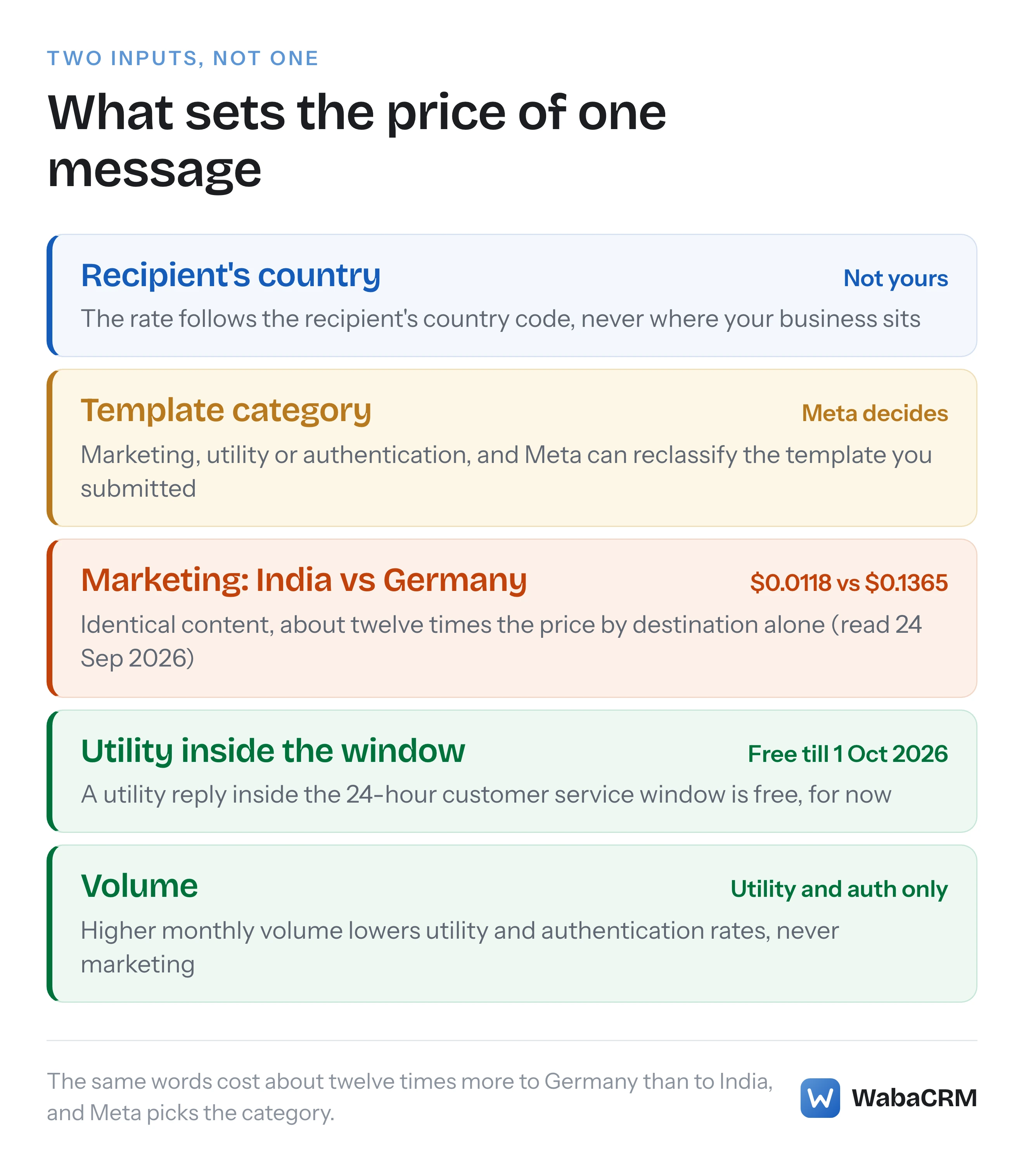
Two things set the price of a WhatsApp template message: its category — marketing, utility or authentication — and the country calling code of the recipient's number. Meta charges per delivered template, bills you directly, and the same marketing message can cost roughly twelve times more to one country than another. Checked 24 September 2026.
What decides the cost of a WhatsApp message?
Two inputs decide it, and neither is a flat fee. Meta's pricing documentation states it plainly: "Rates vary based on the template's category and the recipient WhatsApp phone number's country calling code." (Meta - WhatsApp pricing)
So the price of one message is a function of two things you do not always control: what category Meta assigns the template — marketing, utility or authentication — and which country the recipient's number belongs to. A single headline figure for "the WhatsApp API" cannot capture that, because the same words sent to two customers in two countries are two different prices on the same day.
The other half of the model is when the charge happens at all. Meta charges "on a per-message basis" and, in its own words, "You are only charged when a template message is delivered." (Meta - WhatsApp pricing) A broadcast to ten thousand recipients is ten thousand separate, individually-priced charges, not one. Checked against Meta's documentation on 24 September 2026.
- What decides the cost of a WhatsApp message?
- Why does the same message cost more to one country than another?
- Which country's rate applies, yours or the recipient's?
- What is the difference in price between marketing, utility and authentication?
- Can Meta change the category you chose, and what does that cost?
- Which WhatsApp messages are free, and until when?
- How does message volume change the rate?
- What changes on 1 October 2026?
- How do you estimate your own WhatsApp bill?
Why does the same message cost more to one country than another?
Because the rate card is per market, and the markets are priced very differently. Read from Meta's own USD rate card on 24 September 2026, a marketing template delivered to a number in India was priced at $0.0118, while the same marketing template to a number in Germany was $0.1365 (Meta - WhatsApp pricing). That is roughly a twelve-fold difference for identical content, decided entirely by the destination.
This is the single fact most pricing pages leave out, because it is inconvenient for a headline number. A business sending only within India sees one economics; a business messaging customers across Europe, the Gulf and South Asia sees another, and no single "cost per WhatsApp message" describes both. The number that actually matters to you is your blended rate — the average across your real destination mix — and that is a figure only you can compute, because only you know where your customers are.
Meta groups countries into named markets and a set of regional "Rest of" buckets, and it can move a country out of a regional bucket to stand on its own with a market-specific rate. It gives notice when it does, but the direction is not always down. The safe assumption is that your cost per country is whatever Meta's current rate card says today, not what someone quoted you last year.
Which country's rate applies, yours or the recipient's?
The recipient's, without exception. Meta is direct about this: "Charges for messages are based on the country calling code of the recipient WhatsApp phone number." (Meta - WhatsApp pricing)
Where your business is registered does not enter into it, and neither does the country your WhatsApp Business Account was created in. A business in Dubai messaging customers in India pays India's rate on those messages; the same business messaging customers in the United Kingdom pays the United Kingdom's rate on those. The country code on each recipient's number is the only geography that touches the bill.
This has a planning consequence worth stating out loud. If you are modelling the cost of a campaign, you cannot multiply your total send volume by one rate. You have to split the audience by destination country, apply each country's rate, and sum — which is exactly the calculation a free WhatsApp cost calculator exists to do, because doing it by hand across a dozen markets is where estimates quietly go wrong.
What is the difference in price between marketing, utility and authentication?
Category is the second input, and the three charged categories are not close in price. Marketing is the most expensive in every market; utility and authentication are far cheaper, and in many markets are priced identically to each other. The gap between a marketing rate and a utility rate in the same country is routinely five to ten times.
| Category | What it is for | Charged when |
|---|---|---|
| Marketing | Promotions, offers, re-engagement, anything not strictly transactional | Always, on delivery |
| Utility | Order updates, alerts, account notifications tied to a transaction | On delivery outside the customer service window; free inside it until 1 Oct 2026 |
| Authentication | One-time passcodes and login verification | Always, on delivery |
| Service | Non-template replies to a customer | Free until 1 Oct 2026 |
That price gap is why category assignment is not a labelling detail — it is the difference between a cheap message and an expensive one. And it is not always yours to decide, which the next section covers.
Can Meta change the category you chose, and what does that cost?
Yes, and it is the most common reason a WhatsApp bill rises with no change in volume. Meta evaluates a template's actual content against the category you declared, and can reassign it. The direction that costs you money is utility to marketing, because marketing is dearer in every market.
The mechanics of that reassignment — how it is decided, what the webhook reports, and the window you have to contest it — are their own subject, covered in full at why WhatsApp changed your utility template to marketing rather than repeated here. The point for pricing is narrower: a template you built and priced as utility can start billing at the marketing rate without you sending a single extra message, so the category recorded against each delivered message, not the category you originally chose, is the one that decides the charge.
This is also why reading your own delivered-message data by category matters. A month-on-month cost rise with flat volume is almost always a reclassification, because Meta may only change its published rates on quarter boundaries. Telling the two apart is the subject of reading what Meta actually charged you.
Which WhatsApp messages are free, and until when?
Several, and the list is shrinking on a known date. Messages a customer sends to you are never charged. Non-template replies you send inside an open 24-hour customer service window are free. Beyond that, Meta documents two specific free cases for templates.
The first is utility inside the window: "As of July 1, 2025 - Meta does not charge for utility templates in response to users (delivered within an open customer service window)." (Meta - WhatsApp pricing) The second is the free entry point window: "All messages, including template messages, are free for 72 hours, if sent within an open free entry point window." (Meta - WhatsApp pricing)
Both of those free cases, and the free status of service messages, change on 1 October 2026 — which is its own section below. For now the honest summary is that free-inside-the-window is a real saving today and a disappearing one soon, so a cost model built on it needs a date attached.
How does message volume change the rate?
For two categories, not three. Meta states: "As of July 1, 2025 - You can unlock lower rates for utility and authentication template messages, based on messaging volume." (Meta - WhatsApp pricing)
Marketing is absent from that sentence on purpose. A large marketing broadcast does not get cheaper per message as it grows; the marketing rate is the marketing rate. Utility and authentication, by contrast, have volume tiers, and Meta aggregates the count at the business portfolio level across all of a portfolio's accounts, per market and per category. Volume you send to one country counts towards that country's utility tier, not a single global one.
The practical effect is that a business whose traffic is mostly authentication codes and order updates can see its average rate fall as it scales, while a business whose traffic is mostly marketing cannot. Two companies sending the same number of messages to the same countries can have materially different bills purely from that mix. It is another reason a single quoted rate is a starting point rather than a promise.
What changes on 1 October 2026?
Three of the free cases above become billable. Meta's pricing calendar is fixed — "Meta may update pricing only on the 1st day of each quarter, thus up to 4 times per year" (Meta - WhatsApp pricing) — and the 1 October 2026 update is a significant one.
From that date, Meta begins charging for service messages, and its documentation says "rates for service messages will be the same as those of utility and authentication, by market." (Meta - WhatsApp pricing) It also begins charging for utility templates sent in reply to a customer inside the window, which are free today. There is one softening: a new monthly free tier, where "Each business phone number has one shared free tier of 1,000 delivered service messages per month." (Meta - WhatsApp pricing)
If your current cost model leans on free in-window utility replies or free service messages, it will understate your bill after that date. The full detail of the change is covered at what changes on 1 October 2026 for service message pricing.
How do you estimate your own WhatsApp bill?
Split it in two, because it is two bills. The first is Meta's per-message fees, which you have now seen depend on category and destination country. The second is whatever software you use to send and manage the messages, which is a separate charge from a separate company.

On that second bill, one structural fact is worth checking against whoever you use. WabaCRM is a Meta-verified Tech Provider, not a Meta Business Partner and not a reseller of Meta's messaging, which means it cannot resell Meta's per-message fees and adds no markup on them — Meta bills you directly, at Meta's published rate. That is not true of every platform; some add a per-message markup on top of Meta's rate and charge per agent seat as well. To put real numbers on both halves for your own countries and volumes, the free WhatsApp cost calculator adds Meta's fees to the platform fee, and the WhatsApp Business API pricing in India guide works through a single-market example end to end.
One last honest note that belongs in any cost model: WabaCRM does not quota-enforce inbound lead capture, so a free workspace can drift past its contact allowance with no action by its owner, because losing a real customer's message is worse than a small overage. That is a deliberate design choice, not an oversight, and it is the kind of edge a pricing page should disclose rather than bury.
Every Meta quotation on this page was read from Meta's own documentation on 24 September 2026. Meta changes that documentation without notice; the linked pages are authoritative and this one is not.
Questions people also ask
Does WhatsApp charge per message or per conversation now?
Is the rate based on my country or the customer's country?
Which WhatsApp messages are free?
Why did my WhatsApp costs go up without my sending more messages?
Does sending more messages make each one cheaper?
- whatsapp pricing
- whatsapp business api
- per-message pricing
- marketing messages
- utility messages


