The WhatsApp Groups API: Real, With Sharp Limits
The short answer
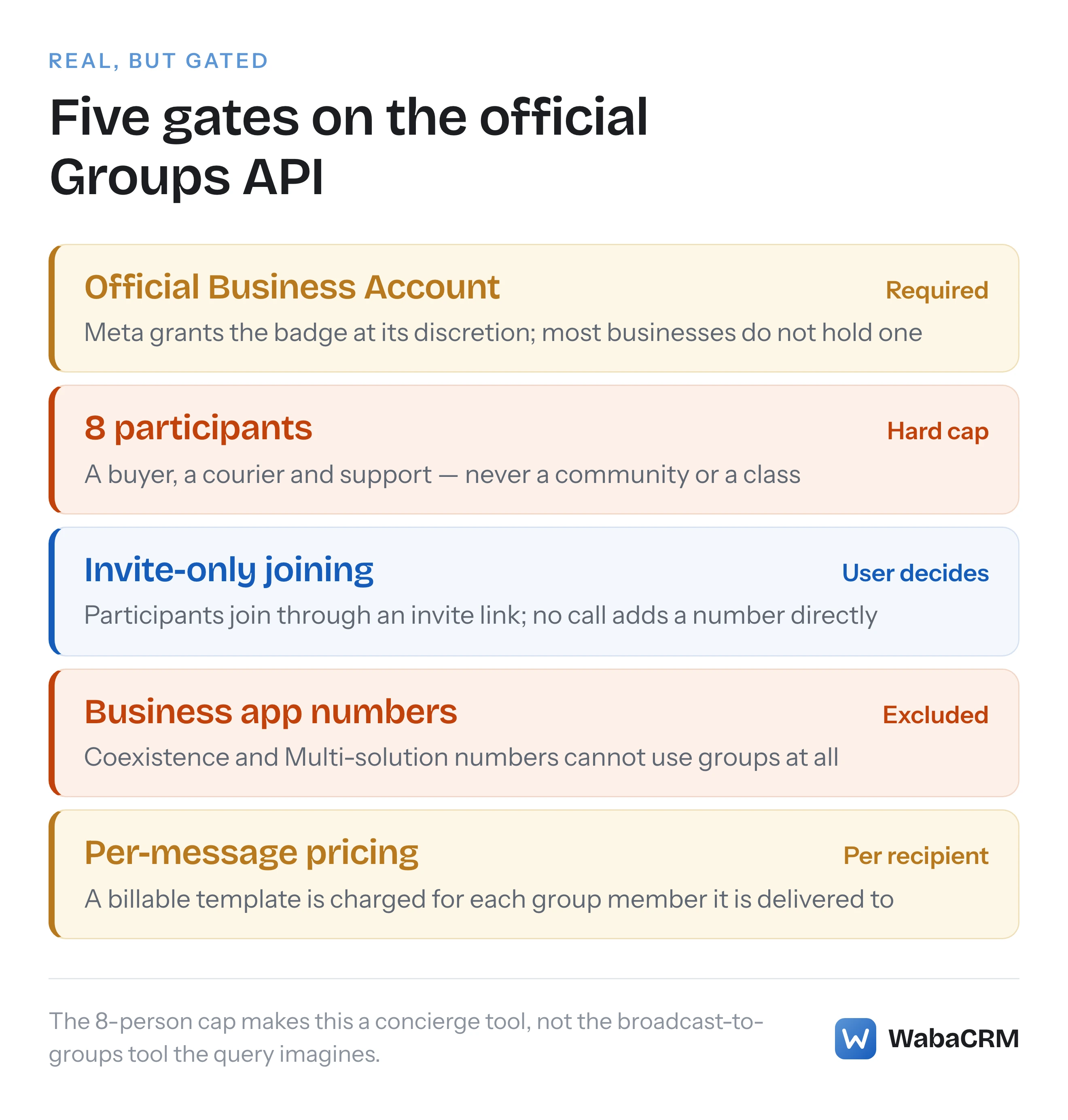
Meta's Groups API is real: a business can create and message WhatsApp groups through the Cloud API. But it is open only to businesses with an Official Business Account, a group holds a maximum of 8 participants, and WhatsApp Business app and Multi-solution numbers are excluded. Checked against Meta's documentation on 25 September 2026.
Is there an official WhatsApp API for groups?
Yes — since 2026 there is, and that is genuinely new. Meta's Groups API lets a business create WhatsApp groups and message them through the Cloud API, documented at its own section of the WhatsApp Business Platform docs.
For years the honest answer to this query was "no, and anything claiming otherwise is automating the consumer apps against WhatsApp's terms". A whole category of unofficial "WhatsApp group API" tools grew up in that gap. The official answer has now changed — but from "does not exist" to "exists, with limits sharp enough to disqualify most of the people searching for it". Two of those limits do the disqualifying on their own: eligibility is restricted to businesses holding an Official Business Account, which Meta grants at its own discretion, and a group tops out at 8 participants, which rules out every community, class, society and broadcast use the phrase "WhatsApp group" usually brings to mind.
- Is there an official WhatsApp API for groups?
- Who is actually eligible for the Groups API?
- How many people can a group created this way hold?
- How do participants end up in your group?
- How are messages in a group charged?
- Which phone numbers are shut out of groups?
- Which features work inside an API-created group?
- What about the unofficial group APIs people used instead?
- What is an 8-person group actually good for?
Who is actually eligible for the Groups API?
Meta's Groups documentation opens with a sentence that reads like a wide door:
"The Groups API is now open to all businesses with an Official Business Account (OBA)." (Meta — WhatsApp Groups API)
and repeats the condition as a requirement further down:
"To qualify for groups features, your business must be an Official Business Account (OBA)." (Meta — WhatsApp Groups API)
The qualifier is the whole sentence. An Official Business Account is the account with the verified badge beside its name, and Meta awards that badge at its own discretion — there is no form a business fills in that guarantees one, and most businesses on the platform, including most verified businesses, do not have it. How the badge is actually granted, and what it is not, is its own subject; the short version that matters here is that "open to all businesses with an OBA" means open to the minority of businesses Meta has already chosen to badge. Everyone else reads the announcement, reaches for the endpoint, and is not eligible.
That framing matters for planning. If your roadmap has "add WhatsApp groups" on it and your account does not carry the badge, the dependency is not an integration task — it is a discretionary grant from Meta with no published timeline and no purchase path.
How many people can a group created this way hold?
Eight. Meta's limits table states it in four words:
"Max group participants: 8" (Meta — WhatsApp Groups API)
The same table sets the other two structural numbers: "Max groups you can create: 10,000 per business number" and "Max Cloud API businesses per group: 1" (Meta — WhatsApp Groups API). Read together, the three numbers describe the intended shape precisely: very many, very small groups, each owned by exactly one business. That is a buyer, a courier and a support agent in one thread. It is not a customer community, a batch of students, a residents' association or anything else the word "group" means to a consumer, where the consumer product itself holds over a thousand members.
The gap between that shape and what the search query imagines is wide enough to deserve a table:
| What the query imagines | What Meta shipped | |
|---|---|---|
| Size | Hundreds of members | 8 participants |
| Eligibility | Any business | Official Business Account only |
| Joining | Add members by number | Invite link, user opts in |
| Purpose | Broadcast to communities | Small service threads |
If the reach of a community is what you are actually after, the constraint that binds you is not group mechanics at all — it is your number's messaging limit, which is what actually caps how many people you can reach with one-to-one template sends.
How do participants end up in your group?
By choosing to. Meta's documentation is explicit that a business cannot pull people in:
"Groups are an invite-only experience where participants join using a group invite link you send them." (Meta — WhatsApp Groups API)
and the page adds the reason the link is the mechanism: "This invite link provides context about the group, helping the user decide whether they want to join." (Meta — WhatsApp Groups API) The feature list backs this with "Groups with join requests enabled", "Get and reset group invite link" and a dedicated "Send group invite link template message", alongside "Remove group participants" for the other direction.
So the consent model is built into the plumbing: you create the group, you send a link, and each person decides. There is no documented call that adds a phone number straight into a group, which is exactly the abuse the unofficial tools sold. Worth noting for anyone building on this early: Meta's Groups overview page does not describe the webhook payload for an inbound group message — the feature list simply names "Send group messages", "Receive group messages" and "Pin and unpin group message" — and it does not state whether a newly joined participant can see messages sent before they joined. Neither silence is an answer; both are questions the overview page leaves to the sub-pages and to testing.
How are messages in a group charged?
The overview page says only that "The Groups API uses per-message pricing" (Meta — WhatsApp Groups API) and links a dedicated pricing page. That page carries the sentence that changes the arithmetic:
"Groups API uses Cloud API's per-message pricing model to determine if a given message is billable. However, you are charged each time a billable message is delivered to someone in the group." (Meta — Groups API pricing)
Per recipient delivered, not per send. One billable template into a group is charged once for every participant it reaches, so a group multiplies the cost of a billable message by its membership rather than sharing it. The cap of 8 keeps that multiplication small, but it is the model to build your cost estimates on.
The same page documents two things that pull the other way. First, a group has its own customer service window: when a participant messages the group, a window opens — with the entire group, not just that person — and Meta says of it, "This allows you to send utility and marketing template messages, or free form messages, for free." (Meta — Groups API pricing) Free messages arrive with pricing.type set to free_group_customer_service, and the page also lists a GROUP_SERVICE category described as "Group messages that were not charged". Second, a ceiling on the discounts you might have expected: "Group utility messages are not eligible for volume tiers." (Meta — Groups API pricing) An active group where customers reply is therefore cheap to serve; a quiet group you push templates into is billed per member, at list rates.
Do not quote specific per-message rates from memory when estimating this — the rates themselves live on Meta's Cloud API pricing pages and change on quarter boundaries.
Which phone numbers are shut out of groups?
This is the exclusion that will surprise the most WabaCRM-shaped readers. Meta states it in one sentence:
"Groups are not available for WhatsApp Business app phone numbers and phone numbers onboarded to Multi-solution Conversations." (Meta — WhatsApp Groups API)
The first half catches coexistence. A coexistence number is a number that stays live in the WhatsApp Business app on the owner's phone while mirroring to the Cloud API — which makes it, in Meta's terms, a WhatsApp Business app phone number, and therefore ineligible for API groups. That lands on top of the other things coexistence already gives up: broadcast lists, disappearing messages and view-once are disabled in the app, and throughput is capped. If groups matter to you, they become one more entry on the list of reasons to weigh full API onboarding against coexistence rather than treating the two as equivalent.
The second half, Multi-solution Conversations, excludes numbers set up to work across more than one provider's solution. The pattern across both halves is consistent: the Groups API is for numbers that live wholly on the Cloud API, under one business, on one solution.
Which features work inside an API-created group?
Meta's overview lists the management surface plainly: "Create and delete group", "Get group info", "Get active groups", "Update group settings", the invite-link calls, and participant removal. On the messaging side, the supported types are "Text, media, text-based templates, and media-based templates" (Meta — WhatsApp Groups API).
The unsupported list is longer than the supported one, and two entries will bite integrations that assume feature parity with one-to-one messaging:
| Works in a group | Does not work in a group |
|---|---|
| Text and media messages | Interactive, commerce and authentication messages |
| Text-based and media-based templates | Disappearing and view-once messages |
| Pin and unpin a message | Editing or deleting a sent message |
| Removing a participant | Calling — "The Calling API is not supported in groups" |
The absence of interactive messages means no buttons, no lists and no Flows inside a group thread — the conversational building blocks most Cloud API integrations lean on hardest are one-to-one only. And one line from the template documentation deserves its own warning for anyone reporting on sends: "Performance metrics are not available for message templates used in Groups" (Meta — WhatsApp Groups API), so a template's analytics will silently understate its real use once groups carry some of it.
What about the unofficial group APIs people used instead?
The tools that have answered this search for years — browser extensions and hosted services that drive WhatsApp Web or a farm of phones to join groups, scrape members and blast messages — were never APIs in any meaningful sense. They automate the consumer clients, which is the conduct WhatsApp's terms prohibit, and numbers that run them get banned, often in batches when a detection pass lands. The difference between the WhatsApp Business app and the API exists precisely because Meta routes programmatic use through a surface it can meter and police.
The Groups API partially replaces that category, and the shape of the replacement is instructive: everything the grey tools sold is what the official version refuses. They added members without asking; the official version is invite-only. They targeted existing consumer groups; the official version only touches groups the business created. They promised unlimited reach; the official version caps a group at 8. A business that wanted the grey-tool behaviour will not find it here — and that is by design, not an early-version gap that will be relaxed once the feature matures. The consent mechanics are the product.
What is an 8-person group actually good for?
Concierge work. The thread that holds a buyer, the delivery rider and a support agent for the life of one order. A property viewing with the tenant, the landlord and the agent. A patient, a coordinator and a specialist arranging an appointment. A premium account with its named account manager and a technical contact. Every one of those is a conversation that today gets scattered across two or three separate one-to-one chats with a human relaying between them; a small group replaces the relaying, and 10,000 groups per number means the pattern can run per order rather than per customer.
What it is not good for is the everyday work most businesses actually do on WhatsApp, which remains one-to-one at volume: campaigns to consenting contacts, an inbox a team answers together, automations on inbound messages. That work runs on the plain Cloud API with no badge requirement, and keeping track of who those conversations belong to is a contact-management problem before it is a messaging one.
For transparency: WabaCRM, a Meta-verified Tech Provider on the Cloud API, does not offer Groups API support today — the feature is too new and too narrowly gated to build against for a customer base that mostly does not hold an Official Business Account. If Meta widens eligibility beyond OBAs, that calculation changes, and the eligibility sentence quoted at the top of this page is the one to watch.
Every Meta quotation on this page was read from Meta's own documentation on 25 September 2026. Meta changes that documentation without notice; the linked pages are authoritative and this one is not.
Questions people also ask
Can I broadcast to existing WhatsApp groups through the API?
Do I need the green tick before I can create groups through the API?
Are group messages charged per group or per recipient delivered?
Can a coexistence number create or join API groups?
How many groups can one business number create through the API?
- whatsapp groups api
- whatsapp cloud api groups
- create whatsapp group api
- official business account
- whatsapp group limits


