Is the WhatsApp Business API End-to-End Encrypted?
The short answer
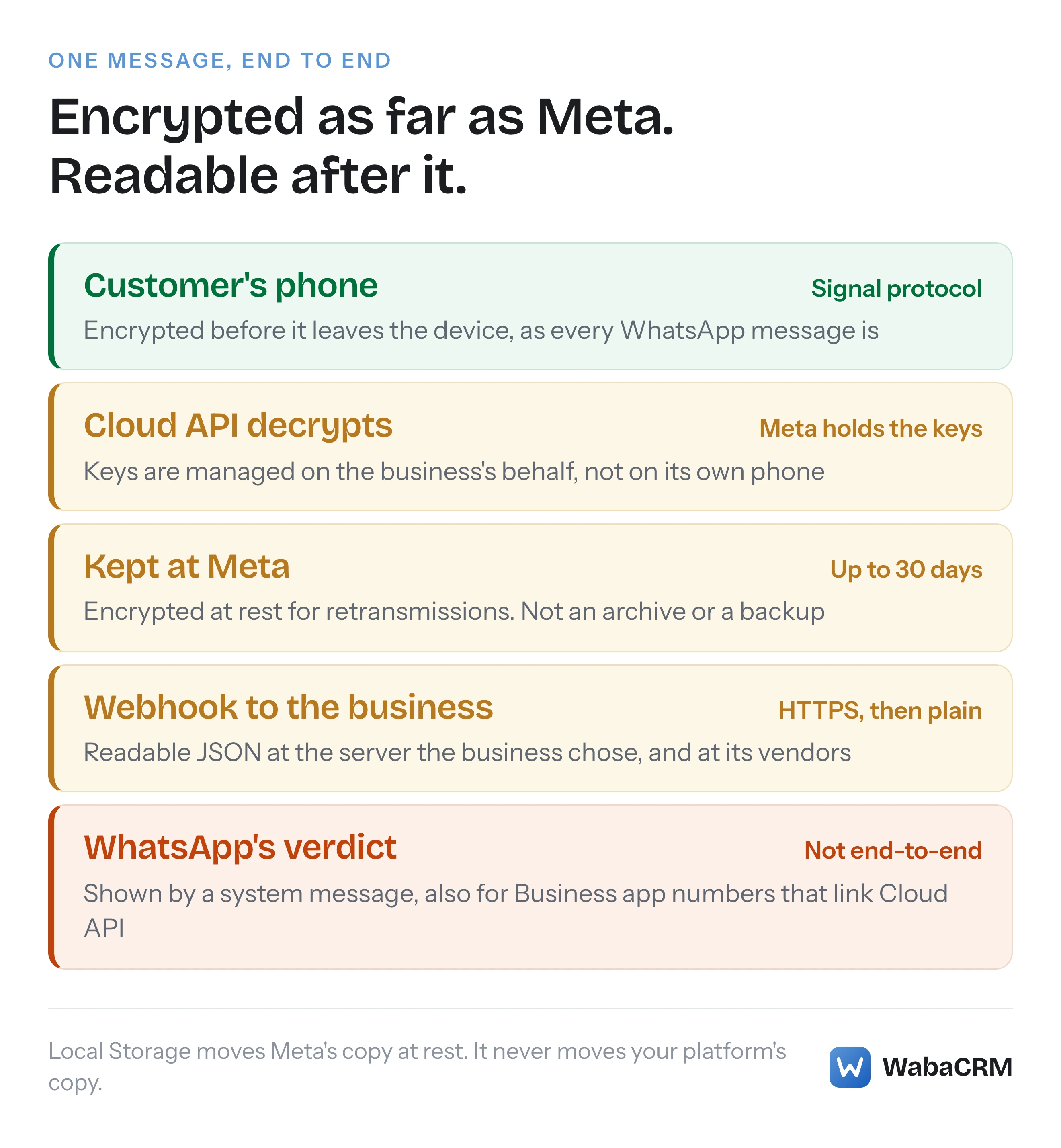
No. WhatsApp's encryption white paper says it "does not consider communications with Meta services, or communications with businesses using Cloud API, to be end-to-end encrypted". Messages are Signal-encrypted from the customer's phone to the Cloud API, which decrypts them, manages the keys for the business and keeps message data up to 30 days (checked October 2026).
Is the WhatsApp Business API end-to-end encrypted?
No, not in the sense WhatsApp uses for personal chats. WhatsApp's technical white paper on encryption says so by name:
"WhatsApp does not consider communications with Meta services, or communications with businesses using Cloud API, to be end-to-end encrypted." (WhatsApp — Encryption Overview technical white paper, February 2026)
It gives the reason in its section on the Cloud API: "Since such communications are not delivered directly to an endpoint controlled by the organization, WhatsApp does not consider communications with businesses using Cloud API to be end-to-end encrypted." Meta decrypts each message on the business's behalf before passing it on.
WhatsApp's Help Center says the same in plainer words. Its example of an optional service is a business choosing "WhatsApp’s parent company, Meta, to securely store messages and respond to customers", and then:
"When businesses use these optional services, we display this clearly in the chat and do not consider messages with these businesses to be end-to-end encrypted. The encryption status of an end-to-end encrypted chat can’t change without being visible to the user." (WhatsApp Help Center — About end-to-end encryption)
Every WhatsApp message is still encrypted with the Signal protocol on its way between the customer's phone and Meta. What changes is where the far end of that encryption sits: in a personal chat, the other person's phone; with the Cloud API, Meta, acting for the business, which then sends the message on to the business's own server as readable JSON. A privacy notice or sales page that calls a Cloud API number "end-to-end encrypted" describes the first half of that journey and leaves out the second.
- Is the WhatsApp Business API end-to-end encrypted?
- Where does a WhatsApp Cloud API message get decrypted?
- Who holds the encryption keys for a Cloud API number?
- How does encryption differ between the Business app, the Cloud API and AI from Meta?
- What does a customer see when a business chat is not end-to-end encrypted?
- How long does Meta keep WhatsApp Cloud API messages?
- Can WhatsApp Cloud API data be stored in India?
- What does the No Storage setting trade away?
- What happens to a message once it reaches the business's platform?
- What should a privacy notice say about WhatsApp Business messages?
Where does a WhatsApp Cloud API message get decrypted?
At Meta, inside the Cloud API, before it is forwarded to the business. Meta's data privacy page for the Cloud API describes both directions:
"When a user sends a message to a business that uses Cloud API, the message travels encrypted via WhatsApp between the user and Cloud API. Once Cloud API receives the message, Cloud API decrypts the message and forwards it to the business. When a business uses Cloud API to send a message to a user, the reverse applies. Upon receiving a message from a business, Cloud API will encrypt the message using the Signal protocol before sending it to the user via WhatsApp." (Meta — Data Privacy & Security)
In practice, "forwards it to the business" means a webhook. Meta's own example of a text message, trimmed:
{
  "object": "whatsapp_business_account",
  "entry": [{
    "changes": [{
      "value": {
        "messaging_product": "whatsapp",
        "contacts": [{ "profile": { "name": "Sheena Nelson" }, "wa_id": "16505551234" }],
        "messages": [{
          "from": "16505551234",
          "type": "text",
          "text": { "body": "Does it come in another color?" }
        }]
      },
      "field": "messages"
    }]
  }]
}
(Meta — Text messages webhook reference)
The customer's name, number and words arrive as plain text inside the JSON. The transport is protected, and Meta says how: "Cloud API uses industry standard encryption techniques to protect data in transit and at rest. Cloud API uses Graph API for sending messages and Webhooks for receiving events, and both operate over industry standard HTTPS, protected by TLS." (Meta — About the WhatsApp Business Platform) TLS ends at the server that receives the request. From that point the message is whatever that server makes of it.
The webhook is also signed, which proves the body came from Meta and was not altered on the way. A signature is about origin, not secrecy; how to check it correctly is in the guide to X-Hub-Signature-256.
Who holds the encryption keys for a Cloud API number?
Meta does, on the business's behalf. Meta's own FAQ on the same page answers the question directly:
"In order to send and receive messages through Cloud API, Cloud API manages the encryption/decryption keys on behalf of the business." (Meta — Data Privacy & Security)
And the message-flow section explains who the customer's phone is actually negotiating with: "Per the Signal protocol, the user and Cloud API, acting on behalf of the business, negotiate encryption keys and establish a secure communication channel."
WhatsApp's white paper answers the same question from the other side:
"The WhatsApp server has no access to the client’s private keys, though if a business user delegates operation of their Whatsapp Business API to a vendor, that vendor will have access to their private keys - including if that vendor is Meta." (WhatsApp — Encryption Overview technical white paper)
So any claim that Meta cannot read Cloud API message content at any point does not survive Meta's own documentation. A service that manages the decryption keys and decrypts the message has the plaintext by construction. What limits Meta is its role, and Meta states that role with its own qualifier:
"To the extent any data protection or privacy law applicable to you recognizes the concepts of “data processor” or “service provider” as defined within those laws, Meta, in providing Cloud API service, acts as a data processor/service provider on behalf of the business. Cloud API will only use the messages it processes on behalf of and at the instruction of the business, unless otherwise directed. Cloud API will not automatically use WhatsApp messages to inform the ads that a person sees." (Meta — Data Privacy & Security)
That is a contractual limit. It is worth having, and it is not the same promise as end-to-end encryption.
How does encryption differ between the Business app, the Cloud API and AI from Meta?
WhatsApp draws the line by who operates the far end. Chats with a person, and with a business on the WhatsApp Business app alone, count as end-to-end encrypted; chats with a business using a service from Meta do not. The white paper puts the rule in one sentence: "When chatting with an organization that uses the WhatsApp Business API, WhatsApp determines the end-to-end encryption status based only on the organization’s choice of who operates its endpoint."
| Who the customer is messaging | End-to-end, in WhatsApp's terms? | Who can read it after delivery |
|---|---|---|
| Another person | Yes | Only the two people in the chat |
| A business on the WhatsApp Business app | Yes, by default | The business, and anyone it designates |
| A Business app number with Cloud API linked | No | Meta, then the business and its vendors |
| A business on the Cloud API | No | The Cloud API, then the business and its vendors |
| A business using AI from Meta | No | Meta, which receives the chats |
The Cloud API rows come from the white paper; the others are worded in WhatsApp's Help Center article. For personal chats: "No one outside of the chat, not even WhatsApp, can read, listen to, or share them." For the app: "WhatsApp considers chats with businesses that use the WhatsApp Business app to be end-to-end encrypted by default. Once a message is received by a business, it will be subject to the business’s own privacy practices."
For AI from Meta the article is blunter: "Meta will receive these chats to improve its AI quality and generate message responses; when this happens we will let you know by highlighting “uses AI from Meta” under the business name." And for third-party agents, which use a service from Meta to manage chats: "Because messages with third-party agents are managed by a service from Meta on behalf of the agent, these conversations are not considered end-to-end encrypted." (WhatsApp Help Center — About end-to-end encryption)
The Help Center article is silent on one case: a number that runs in the WhatsApp Business app and on the Cloud API at the same time, which is what WhatsApp coexistence does. The white paper is not. It says that "As of 2024, businesses may link Cloud API as a companion to their WhatsApp Business app", and that as a result:
"WhatsApp does not consider 1-1 chats with businesses that link Cloud API to be end-to-end encrypted since messages and calls in these 1-1 chats are shared by the business to Meta to process the messages and calls on behalf of the business." (WhatsApp — Encryption Overview technical white paper)
So connecting a Business app number to a platform through coexistence changes its one-to-one chats from end-to-end encrypted to not.
What does a customer see when a business chat is not end-to-end encrypted?
A system message in the chat. WhatsApp says it displays the change "clearly in the chat", and that "The encryption status of an end-to-end encrypted chat can’t change without being visible to the user." The white paper says where else to look: "If the user’s WhatsApp client sees that it’s communicating with a business that uses the WhatsApp Business API, the client will display this to the user. The user can also double check the encryption status within the chat or in the business info section of their app."
Neither document quotes the notice's exact wording, so this page does not. To see it, message your business number from a personal phone.
For a Business app number that has linked the Cloud API, the white paper says the QR code on the encryption screen "can be used to validate the presence of a linked Cloud API companion", and the 60-digit code "can be used to verify all devices except a Cloud API companion".
How long does Meta keep WhatsApp Cloud API messages?
Up to 30 days, encrypted at rest, and Meta is explicit that this is not an archive. The data privacy page gives the figure and the reason:
"Messages have a maximum retention period of 30 days in order to provide the base features and functionality of the Cloud API service; for example, retransmissions." (Meta — Data Privacy & Security)
The same page answers the at-rest question in one sentence, "Cloud API messages at rest are encrypted", and says identifiers go too: "Cloud API uses identifiers as sources or destinations of individual messages; as such, Cloud API deletes them within 30 days of the last status update (sent, delivered, read) of a message, unless otherwise directed."
Section 5.4 of Meta's terms then rules out the obvious fallback:
"Meta does not provide an archiving service, storage service, or any backup functionality; you are solely responsible for creating backups." (Meta Terms for WhatsApp Business Platform)
| Data | How long Meta keeps it | Meta page |
|---|---|---|
| Message content | Up to 30 days | Data Privacy & Security |
| Identifiers on a message | Within 30 days of the last status update | Data Privacy & Security |
| Webhooks your server did not accept | Retried for up to 7 days | No Storage |
| Content, with Local Storage on | Up to 60 minutes outside the chosen country | Local storage |
| Content, with No Storage on | Up to 1 hour, never at rest | No Storage |
The practical consequence: the only lasting copy of a customer conversation is the one your own systems keep from the webhook. If your endpoint is down longer than Meta retries, the message is gone; the webhook retry guide covers how long that window really is.
Can WhatsApp Cloud API data be stored in India?
Meta's copy at rest can be. Local Storage lets a business choose the country where Meta keeps message content at rest, and India is on Meta's list as IN. It does not decide where any other copy lives.
Meta's description of how it works:
"Data-in-use: When message content is sent or received by Cloud API or Marketing Messages API for WhatsApp, message content may be stored on Meta data centers internationally while being processed." … "When using local storage for Cloud API, the data-in-use period is up to 60 minutes." … "Data-at-rest: After the data-in-use period, message content is deleted from Meta data centers outside of the specified local storage region, and persisted only in data centers within the local storage region selected." (Meta — Local storage)
The data_localization_region parameter on Meta's registration page listed 14 supported values when read on 17 October 2026: Australia, Indonesia, India, Japan, Singapore and South Korea; Germany (labelled "EU (Germany)"), Switzerland and the United Kingdom; Brazil; Bahrain, South Africa and the United Arab Emirates; and Canada (Meta — Register a business phone number). The United States is not on it.
On API version 21.0 or newer the setting is applied with the Settings API before the number is registered. Meta's own example for this call uses BR; India appears as IN in the parameter description and in the example for version 20.0 and older. With India, the call reads:
curl 'https://graph.facebook.com/<API_VERSION>/<WHATSAPP_BUSINESS_PHONE_NUMBER_ID>/settings' \
  -H 'Content-Type: application/json' \
  -H 'Authorization: Bearer <ACCESS_TOKEN>' \
  -d '{
    "storage_configuration": {
      "status": "IN_COUNTRY_STORAGE_ENABLED",
      "data_localization_region": "IN"
    }
  }'
Four limits come with it:
- Timing. "Local storage can only be enabled or disabled on WhatsApp Business phone numbers when they are in an unregistered state." A live number has to be deregistered and registered again, and each of those endpoints allows 10 requests per number in a 72-hour moving window, the limit described in the guide to errors 131045 and 133016. Meta also says the deregister endpoint cannot be used on "a business phone number that is in use with both Cloud API and the WhatsApp Business app".
- Scope. It covers message content, meaning text, media and template components, plus "A limited set of metadata attributes".
- The contact book. "The contact book is hosted on Meta data centers, regardless of your local storage configuration."
- Media sharing. Media uploaded by a number with Local Storage on "are only accessible to that specific phone number, and cannot be shared with other phone numbers associated with the business."
And the limit Meta does not need to state: the setting moves Meta's copy. Your webhook server, your CRM and your messaging platform keep their own copies wherever they are hosted.
What does the No Storage setting trade away?
Delivery safety. No Storage keeps Meta's copy for at most an hour and never at rest, and in exchange anything that needs more than an hour to recover is lost.
"“No Storage” is a custom configuration of Cloud API local storage, where the data in-transit is kept for up to an hour in Meta data centers and the data is not persisted at rest (that is to say, not in Meta data centers nor in AWS In-Country stores)." (Meta — No Storage)
Meta lists three costs. Webhook retries drop from up to 7 days to 1 hour, so "If your webhook server is unavailable beyond this window, the webhook (including incoming messages, receipts, etc.) will be permanently lost." A message that fails to decrypt on the customer's phone can be retried only within the hour. And media on incoming messages can be downloaded for up to an hour, after which it "is permanently deleted and cannot be retrieved."
Media you upload is the one exception you control: a ttl_minutes value from 60 to 43,200 (30 days) overrides the one-hour expiry for that file.
A webhook that misses the window is replaced by an error:
"errors": [{
  "code": 131035,
  "title": "Webhook could not be delivered within data retention limit",
  "message": "Webhook could not be delivered within data retention limit",
  "error_data": {
    "details": "Webhook could not be delivered within data retention limit"
  }
}]
The decryption case arrives as error 131036, "Message failed to be delivered on at least one of the user's device", with the detail "Message payload not found". Only 60 minutes is accepted as the retention value. No Storage suits a business whose own system is the record and whose endpoint is reliably up. For everyone else the 30-day default is a safety net worth keeping.
What happens to a message once it reaches the business's platform?
It is governed by the business's own practices and those of whoever it chose to receive it. On the Cloud API that is literal: the readable message is delivered to a server the business picked.
WabaCRM is one of those servers. It is a platform that receives a business's Cloud API webhooks and stores the conversations so a team can read, search, assign and answer them, which means it holds the plaintext. The Message logs screen makes that visible: every message in and out, searchable by its text, exportable to CSV.

What WabaCRM's privacy policy says about that copy, and nothing more:
- What is stored: "The content of messages sent and received through the workspace's connected WhatsApp number, including text, media, and template messages", with delivery states and any error Meta returns. Raw webhook payloads are kept for 30 days, then discarded.
- How long: contacts and conversations are kept "for as long as the workspace exists", and a closed workspace is deleted within 30 days, except invoices kept for tax.
- Where: "Service data is stored on servers in India, operated on our behalf by Contabo Asia Private Limited. Message delivery necessarily involves Meta's infrastructure, which operates globally." That is a statement about where WabaCRM's servers are, not a promise that a conversation never leaves India; it has already passed through Meta's Cloud API on the way.
- Security: traffic over HTTPS, inbound webhooks verified by signature, roles that limit which conversations an agent sees, and WhatsApp access tokens and two-step PINs encrypted at rest. The policy makes no claim that message text is encrypted at the application level, and no one should read one into it.
One more recipient applies only if a workspace switches on the AI Assistant add-on: each AI draft or flow reply sends the thread's recent messages, and each grammar fix or translation sends the draft being edited, to the platform's AI provider. Every service a business connects is one more place the readable text goes.
What should a privacy notice say about WhatsApp Business messages?
What happens, in the order it happens. Customers and auditors both read "end-to-end encrypted" as a promise that nobody but the two ends can read a message, and on the Cloud API that is not true.
- Do not claim end-to-end encryption for a Cloud API number. Say messages are encrypted in transit and processed by Meta's Cloud API on your behalf.
- Name Meta's role. Meta describes itself as a data processor or service provider for the Cloud API where the law has that concept, and keeps messages up to 30 days.
- Name everyone else who receives the text: your messaging platform, your CRM, any AI provider, and where each stores it.
- State your own retention, because Meta's 30 days is not an archive and yours is the copy that lasts.
- Keep sensitive data out of the chat. The WhatsApp Business Messaging Policy says: "Don’t share or ask people to share full length individual payment card numbers, financial account numbers, personal ID card numbers, or other sensitive identifiers." (WhatsApp Business Messaging Policy) For health data, section 4.2 of Meta's terms says plainly that "the WhatsApp Business Platform is not HIPAA compliant".
One detail for Indian readers checking Meta's own FAQ: its compliance question still reads "How does Cloud API comply with regional data protection laws (such as GDPR, LGPD, and PDPB)?" The abbreviation is for a bill. The law India passed is the Digital Personal Data Protection Act, 2023, whose consent and notice duties start in stages, as the DPDP Act guide sets out. Meta's answer to that question also puts the duty where it belongs: "Cloud API customers must meet their own obligations under data protection laws".
Every Meta quotation on this page was read from Meta's and WhatsApp's own documentation on 17 October 2026. Meta changes that documentation without notice; the linked pages are authoritative and this one is not.
Questions people also ask
Can Meta read messages sent through the WhatsApp Cloud API?
Is the WhatsApp Business Platform HIPAA compliant?
Does Local Storage keep every copy of a WhatsApp message in India?
Does Meta keep a backup of a business's WhatsApp Cloud API chats?
Is a chat with a business on the WhatsApp Business app end-to-end encrypted?
- whatsapp business api end to end encryption
- whatsapp cloud api encryption
- whatsapp cloud api data retention
- whatsapp cloud api local storage
- data_localization_region


